
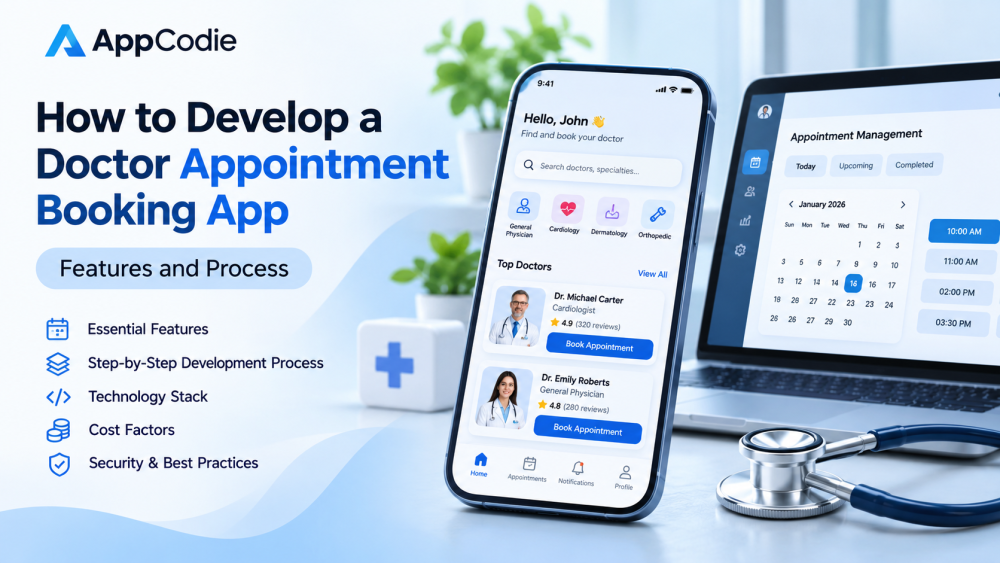
How to Develop a Doctor Appointment Booking App: Features and Process
The healthcare industry is rapidly adopting digital solutions to improve patient experiences and streamline medical services. One of the most practical innovations is the doctor appointment booking app, which allows patients to find doctors, check availability, and schedule appointments without making phone calls or visiting clinics.
For hospitals, clinics, and healthcare startups, investing in doctor appointment booking app development can simplify appointment management, reduce administrative workload, and improve communication between patients and healthcare providers.
In this guide, we will explore the essential features, development process, technology stack, costs, and best practices for building a reliable doctor appointment booking application.
What Is a Doctor Appointment Booking App?
A doctor appointment booking app is a digital platform that connects patients with healthcare professionals and allows them to schedule consultations online.
Patients can search for doctors based on specialization, location, availability, and consultation type. Healthcare providers can manage schedules, confirm bookings, and organize appointments through a centralized system.
A typical appointment booking solution includes three interfaces:
-
Patient App: Allows users to search for doctors, book appointments, and manage their visits.
-
Doctor Panel: Helps healthcare professionals manage availability, appointments, and patient requests.
-
Admin Dashboard: Enables healthcare organizations to manage doctors, users, bookings, and platform operations.
These components work together to create a more organized healthcare appointment management system.
Why Healthcare Businesses Need a Doctor Appointment Booking App
1. Convenient Appointment Scheduling
Patients can schedule appointments at any time without depending on clinic reception hours. This improves accessibility and reduces unnecessary waiting.
2. Reduced Administrative Workload
Automated appointment scheduling minimizes repetitive tasks such as answering booking calls, updating registers, and confirming appointments manually.
3. Improved Patient Experience
A user-friendly booking process helps patients locate suitable healthcare professionals and choose convenient appointment slots.
4. Better Appointment Management
Doctors and clinic administrators can view scheduled consultations, manage availability, and handle cancellations through one platform.
5. Reduced Missed Appointments
Automated reminders through SMS, email, or push notifications can help patients remember upcoming consultations and reduce avoidable no-shows.
6. Improved Business Efficiency
Centralized scheduling provides healthcare organizations with better visibility into appointment demand, doctor availability, and operational performance.
Essential Features of a Doctor Appointment Booking App
The success of a healthcare appointment application depends on its usability, security, and functionality.
1. Patient Registration and Login
Patients should be able to create accounts using email addresses, phone numbers, or supported authentication services.
Important capabilities include secure login, password recovery, profile management, and optional multi-factor authentication.
2. Doctor Search and Filtering
A comprehensive search feature allows patients to find doctors based on:
-
Medical specialization
-
Clinic or hospital location
-
Consultation fees
-
Available appointment slots
-
Consultation mode
-
Verified doctor information
Accurate search filters help patients identify appropriate healthcare providers.
3. Doctor Profiles
Each doctor should have a dedicated profile containing professional qualifications, specialization, experience, clinic information, consultation fees, and available schedules.
Healthcare organizations should verify professional credentials before publishing profiles.
4. Real-Time Appointment Booking
Real-time scheduling is one of the most important features of a doctor appointment booking app.
Patients should be able to view available slots, select a suitable time, and receive booking confirmation.
The system should also prevent double bookings through server-side availability validation and appropriate database controls.
5. Appointment Rescheduling and Cancellation
Patients may need to change appointments because of personal commitments or unexpected circumstances.
A flexible booking system should support rescheduling, cancellations, and clear communication of clinic policies.
6. Automated Notifications and Reminders
Push notifications, SMS messages, and emails can inform users about:
-
Appointment confirmations
-
Upcoming consultations
-
Schedule changes
-
Cancellations
-
Follow-up appointments
Notifications should avoid exposing unnecessary sensitive medical information.
7. Secure Online Payments
Healthcare businesses can integrate payment gateways to collect consultation fees digitally.
Payment features may include transaction confirmation, receipts, refunds, and payment status tracking.
Payment processing should use a trusted provider and avoid unnecessary storage of card information.
8. Doctor Availability Management
Doctors should be able to configure consultation hours, working days, breaks, holidays, and unavailable time slots.
Accurate availability management helps clinics avoid scheduling conflicts.
9. Telemedicine Integration
For healthcare organizations offering remote consultations, video appointments can be integrated into the platform.
Telemedicine functionality may include secure video calls, consultation scheduling, and appropriate access controls.
10. Admin Dashboard
An administrative dashboard provides centralized control over the appointment booking system.
Administrators can manage doctor accounts, patient registrations, appointment records, payment statuses, and operational reports.
Access to sensitive patient information should be restricted according to staff responsibilities.
Step-by-Step Doctor Appointment Booking App Development Process
Developing a successful healthcare booking application requires planning, technical expertise, and continuous testing.
Step 1: Define Business Requirements
Start by identifying the target audience and business objectives.
Determine whether the application is intended for an individual clinic, a hospital network, or a multi-provider healthcare marketplace.
Document essential requirements such as doctor search, scheduling, payment processing, and administrative management.
Step 2: Conduct Market and User Research
Study existing appointment booking platforms to understand common features and user expectations.
Interview patients, doctors, and clinic administrators to identify scheduling difficulties and workflow requirements.
This research helps prioritize useful features rather than adding unnecessary complexity.
Step 3: Design the UI/UX
Create wireframes and interactive prototypes for the patient application, doctor panel, and admin dashboard.
Focus on simple navigation, readable text, accessible forms, and a short appointment booking journey.
The interface should also accommodate users with different accessibility needs.
Step 4: Choose the Technology Stack
Selecting suitable technologies helps create a scalable and maintainable application.
| Component | Technology Options |
|---|---|
| Mobile application | React Native, Flutter |
| Web frontend | React.js, Next.js |
| Backend | Node.js, Laravel |
| Database | PostgreSQL, MySQL, MongoDB |
| Authentication | OAuth 2.0, secure session or token-based authentication |
| Notifications | Firebase Cloud Messaging, email or SMS providers |
| Payments | Razorpay, Stripe |
| Cloud hosting | AWS, Azure, Google Cloud |
The final technology stack should depend on project requirements, infrastructure, security needs, and development budget.
Step 5: Develop the Backend and APIs
Backend development handles essential operations such as user authentication, doctor profiles, appointment availability, booking management, and payment status updates.
Develop secure APIs that connect the frontend with the application database.
Use server-side validation, role-based authorization, and transactional booking logic to maintain data integrity.
Step 6: Build the Patient and Doctor Interfaces
Develop the patient-facing application with registration, doctor search, appointment booking, and notification features.
Create a separate doctor interface for managing schedules and consultations.
Ensure the application works consistently across supported devices and screen sizes.
Step 7: Implement Security and Privacy Controls
Healthcare applications may process sensitive personal and medical information.
Important safeguards include:
-
Encryption of data in transit and at rest
-
Role-based access control
-
Secure authentication
-
Audit logging
-
Regular security testing
-
Data minimization and retention policies
-
Secure backup and recovery procedures
Applicable privacy and healthcare regulations depend on the countries where the platform operates and the nature of the information processed.
Step 8: Test the Application
Before launch, perform functional, usability, performance, compatibility, and security testing.
Pay special attention to simultaneous bookings, appointment cancellations, notification delivery, payment failures, and timezone handling.
Testing should confirm that the same appointment slot cannot be booked by multiple patients.
Step 9: Launch and Maintain the Application
Deploy the application using a reliable hosting environment and establish monitoring for errors, performance, and availability.
After launch, collect user feedback, resolve technical issues, update dependencies, and improve features based on real usage.
How Much Does Doctor Appointment Booking App Development Cost?
The cost of developing a doctor appointment booking app depends on its features, design complexity, supported platforms, security requirements, integrations, and development team.
A basic MVP with doctor profiles and appointment scheduling generally requires less development effort than a comprehensive healthcare platform offering telemedicine, payments, multiple clinics, and advanced administration.
Major cost factors include:
-
Platform selection: Android, iOS, web, or cross-platform development.
-
Feature complexity: Basic scheduling versus advanced integrations.
-
UI/UX requirements: Standard interfaces versus custom designs.
-
Backend architecture: Single-clinic applications versus multi-provider platforms.
-
Security and compliance: Privacy controls, audits, and regulatory requirements.
-
Maintenance: Hosting, monitoring, support, and ongoing updates.
For an accurate development estimate, businesses should prepare a requirements document and request a project-specific quotation.
Common Challenges in Doctor Appointment Booking App Development
Preventing Double Bookings
Concurrent appointment requests can create scheduling conflicts. Database transactions, unique booking constraints, and reliable availability checks help prevent duplicate reservations.
Protecting Patient Information
Healthcare platforms must apply strong security practices to protect sensitive information from unauthorized access.
Managing Schedule Changes
Doctors may become unavailable unexpectedly. The application should support cancellations, rescheduling, and timely patient notifications.
Maintaining Application Performance
The platform should remain responsive as the number of users, doctors, and appointments increases.
Creating a Simple User Experience
Complicated registration and booking processes can discourage patients. Clear navigation and minimal booking steps improve usability.
Future Trends in Doctor Appointment Booking Applications
Healthcare booking platforms continue to evolve as patient expectations and digital healthcare services expand.
Important development directions include:
-
Integrated telemedicine consultations
-
Improved accessibility and multilingual interfaces
-
Automated appointment reminders and follow-up workflows
-
Integration with electronic health record systems
-
Online payments and digital billing
-
Better scheduling analytics for healthcare administrators
Businesses should prioritize features that solve genuine patient and clinic workflow problems.
Why Choose AppCodie for Doctor Appointment Booking App Development?
At AppCodie, we understand the importance of creating practical, user-friendly, and scalable digital solutions for modern businesses.
Our approach to healthcare application development focuses on clear requirements, intuitive interfaces, reliable backend architecture, and maintainable technology.
Whether your business needs a clinic appointment scheduling system, a doctor booking platform, or a custom healthcare mobile application, AppCodie can help plan and develop a solution aligned with your operational needs.
We focus on building applications that simplify workflows and support long-term business growth.
Conclusion
Doctor appointment booking app development offers healthcare organizations an opportunity to simplify scheduling, improve patient convenience, and manage consultations more efficiently.
A successful application requires more than an attractive interface. It needs reliable booking logic, secure data handling, convenient doctor search, and effective administrative tools.
By following a structured development process and choosing the right technology stack, healthcare businesses can create appointment booking platforms that serve patients and medical professionals effectively.
Planning to build a doctor appointment booking app?
Connect with AppCodie to discuss your healthcare application requirements and explore a custom development solution for your business.
Frequently Asked Questions
1. What is a doctor appointment booking app?
A doctor appointment booking app is a digital platform that allows patients to search for healthcare professionals, view availability, and schedule consultations online.
2. How long does it take to develop a doctor appointment booking app?
Development time depends on the application's scope, features, integrations, design requirements, and testing needs. A basic MVP may take several months, while a complex healthcare platform can require significantly longer.
3. Which technology is best for doctor appointment booking app development?
React Native and Flutter are common choices for cross-platform mobile development. Node.js and Laravel can support backend development, depending on project requirements.
4. Can a doctor appointment booking app support online payments?
Yes. Secure payment gateway integrations can allow patients to pay consultation fees online and receive transaction confirmations.
5. Can telemedicine features be added to an appointment booking app?
Yes. Healthcare businesses can integrate video consultations, remote appointment scheduling, and related features when appropriate security and regulatory requirements are addressed.
6. How can healthcare businesses prevent double bookings?
Developers can use transactional booking operations, database constraints, and server-side availability checks to ensure appointment slots are reserved consistently.